
The Oil Surplus Nobody Wanted to Talk About Is Here
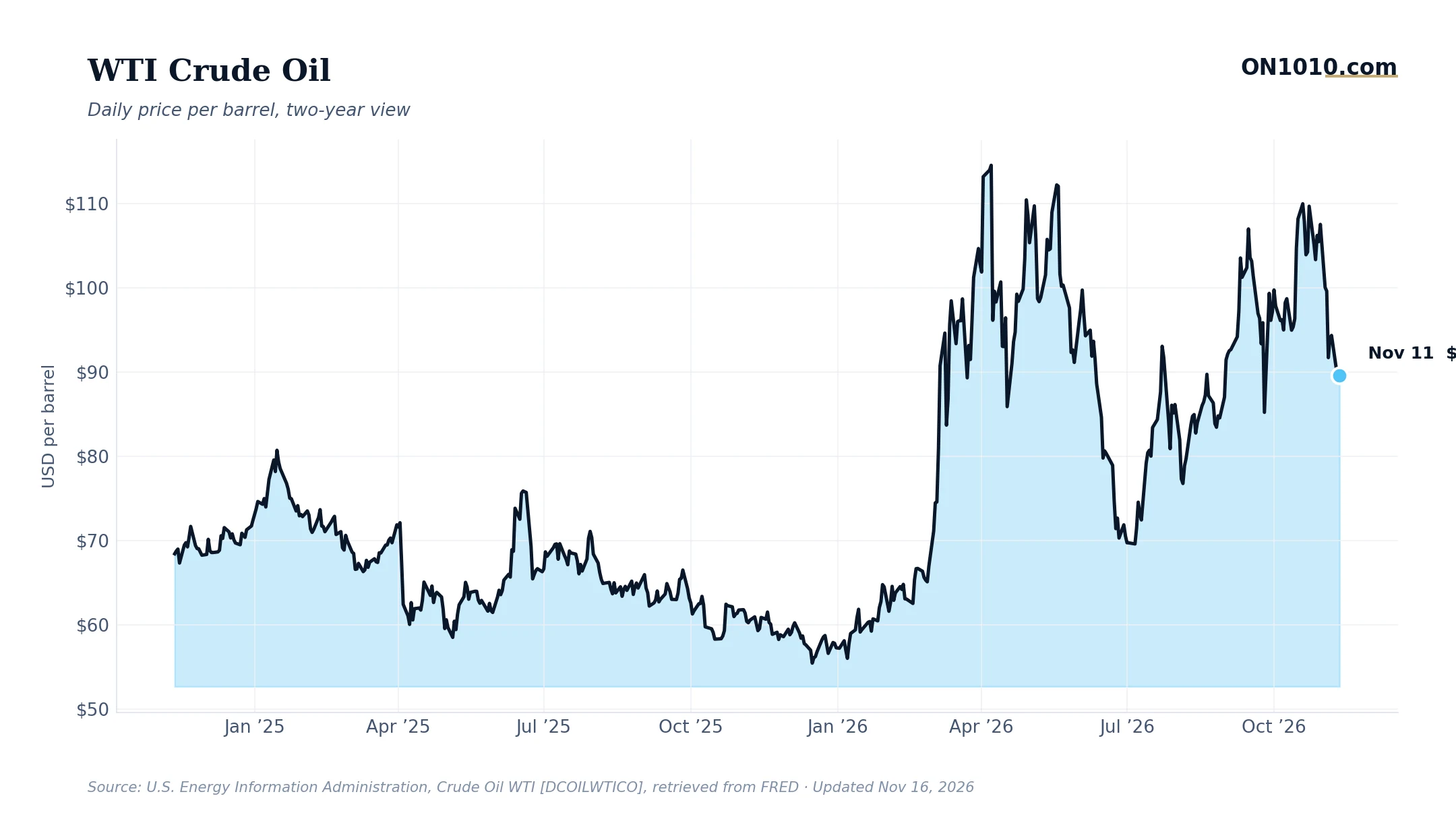
According to CNBC, U.S. crude oil has fallen to $87 a barrel as Middle East export flows recover and fourth-quarter supply forecasts point to a global surplus. The number itself is notable. The timing is more so.
For most of 2026, the conversation around oil centered on supply disruption risk. Middle East tensions kept a floor under prices, and that floor kept energy costs elevated across the economy. Now, as those export flows normalize, the market is repricing quickly. This is a useful reminder of how commodity markets work: the risk premium that gets built in on the way up tends to exit faster than it arrived.
A drop toward $87 matters beyond the pump. Energy is an input cost across nearly every sector of the economy. When oil falls, profit margins in transportation, manufacturing, logistics, and retail have room to expand, even if revenues stay flat. That is a direct mechanism connecting commodity prices to corporate earnings. At the same time, core inflation is running historically hot right now, and the Fed is holding a restrictive policy rate. Lower energy prices won’t fix sticky services inflation on their own, but they do reduce one source of upward pressure. For the Fed, that is a small piece of welcome arithmetic.
The cautionary note is in where the broader market is currently positioned. Defensive sectors, including consumer staples, health care, real estate, and utilities, are all outperforming the broader market by roughly 8 percentage points over the past month. That kind of rotation historically reflects institutional investors reducing risk exposure, independent of what any single commodity is doing. Consumer sentiment is near the bottom of its historical range. Credit spreads are wide. These signals don’t line up with a “problem solved” narrative, and they’re worth weighting.
Historically, investors and operators have used falling energy prices as an opportunity to reassess input cost assumptions in their models, particularly in capital-intensive industries where energy is a meaningful line item. The question worth asking now is whether this decline reflects a genuine, durable supply recovery or a temporary reprieve before the next disruption.
Bottom Line: Falling oil is good news for margins, but the broader backdrop, tight monetary policy, wide credit spreads, and a defensive rotation in equities, says this economy still has real friction to work through.
Read more: CNBC Top News
ON1010 Research is an independent publisher of economic education and is not a registered investment adviser, broker-dealer, or investment company. This content is for educational and informational purposes only and is not investment advice or a recommendation to buy, sell, or hold any security. Published under the publisher exemption recognized by Section 202(a)(11)(D) of the Investment Advisers Act of 1940 (Lowe v. SEC). Always consult a qualified financial professional before making any financial decision.
Free Research
The economy moves fast. We make sure you move faster.
Economic data, policy shifts, and market signals — delivered to your inbox.
Subscribe Free