
The Bond Market Is Pricing In a Slower Economy. Watch It Closely.
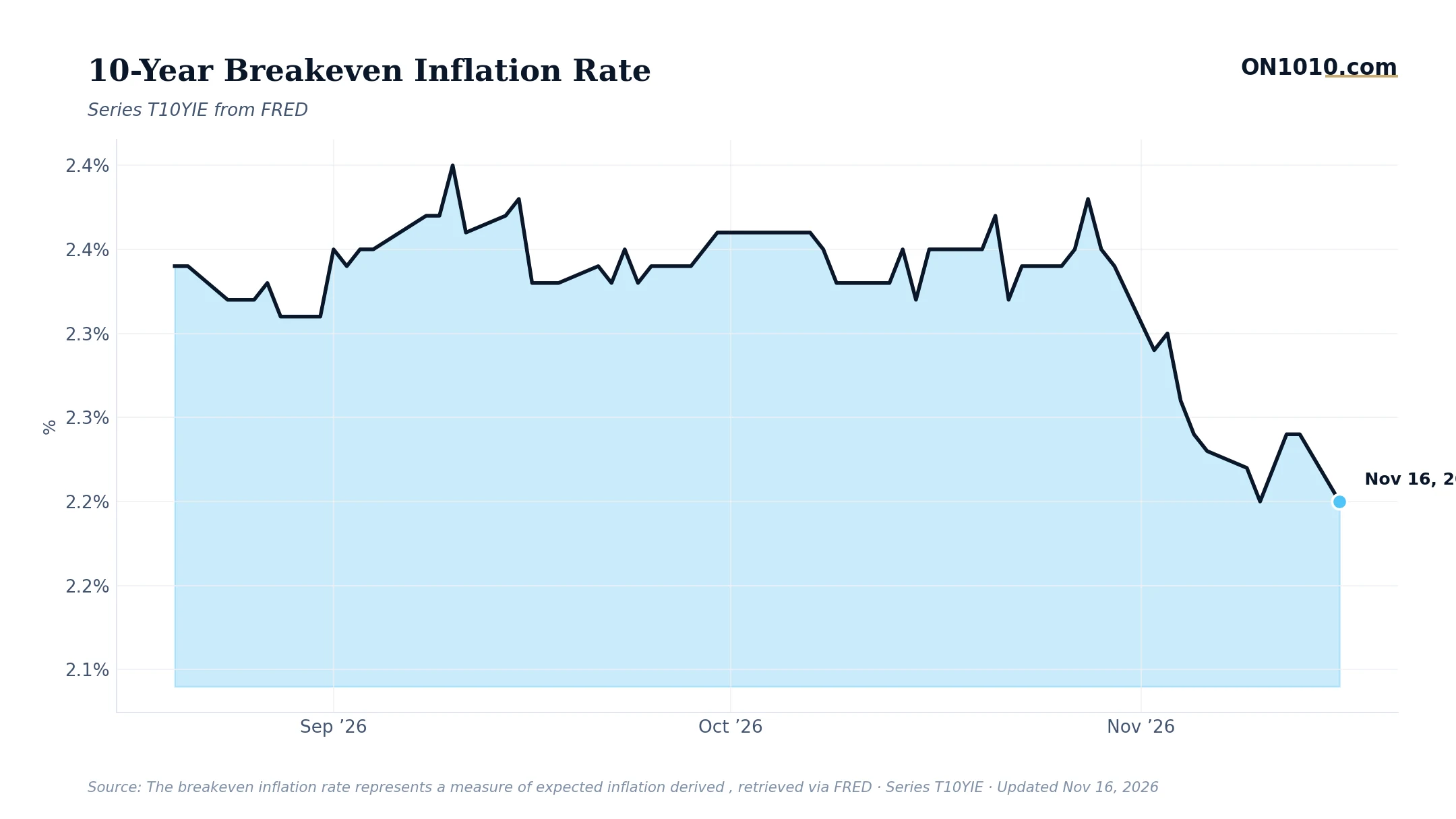
The 10-year breakeven inflation rate slipped to 2.2% on November 16, down from 2.24% just three days earlier. That four basis-point move is small on its own, but it extends a range-bound pattern that has held all month: markets consistently pricing inflation below the Fed’s 2% target threshold, with zero momentum toward higher expectations.
What makes this interesting is the context. Core inflation is running very high by historical standards, yet the market’s forward-looking inflation gauge has drifted lower. That is not a small contradiction. It suggests bond investors believe the current inflation reading reflects conditions that will not persist, possibly because they expect slower growth ahead to do the disinflationary work.
That interpretation fits the broader picture. Long-term interest rates are historically elevated, credit spreads are wide, consumer sentiment is at the low end of its historical range, and monetary policy remains restrictive by most measures. When you see those conditions stacked up together, the economy is operating under real friction. Meanwhile, sector rotation in equities shows all four defensive sectors outperforming the broader market over the past month, with consumer staples and health care both up roughly 8.8% relative to SPY. Technology is down 7.7% against the same benchmark. That is the market’s way of saying it is repositioning away from growth.
Historically, when breakeven inflation rates fall while real rates stay elevated, it has compressed what investors are willing to pay for growth-sensitive assets, since the nominal earnings power that justifies high valuations looks less certain. In past cycles, businesses watching this combination have scrutinized capital expenditure timelines and financing costs more carefully, since the real cost of borrowing stays high even as nominal growth expectations cool.
Bottom Line: Inflation expectations are easing, but that easing is coming from slowing growth expectations rather than a soft landing narrative. The question worth asking: if the bond market is right about where inflation is heading, what else does it think is slowing down to get it there?
Source: Federal Reserve Economic Data (FRED)
ON1010 Research is an independent publisher of economic education and is not a registered investment adviser, broker-dealer, or investment company. This content is for educational and informational purposes only and is not investment advice or a recommendation to buy, sell, or hold any security. Published under the publisher exemption recognized by Section 202(a)(11)(D) of the Investment Advisers Act of 1940 (Lowe v. SEC). Always consult a qualified financial professional before making any financial decision.
Free Research
The economy moves fast. We make sure you move faster.
Economic data, policy shifts, and market signals — delivered to your inbox.
Subscribe Free