
Factory Output Slips. The Trend Underneath Is More Interesting Than the Drop.
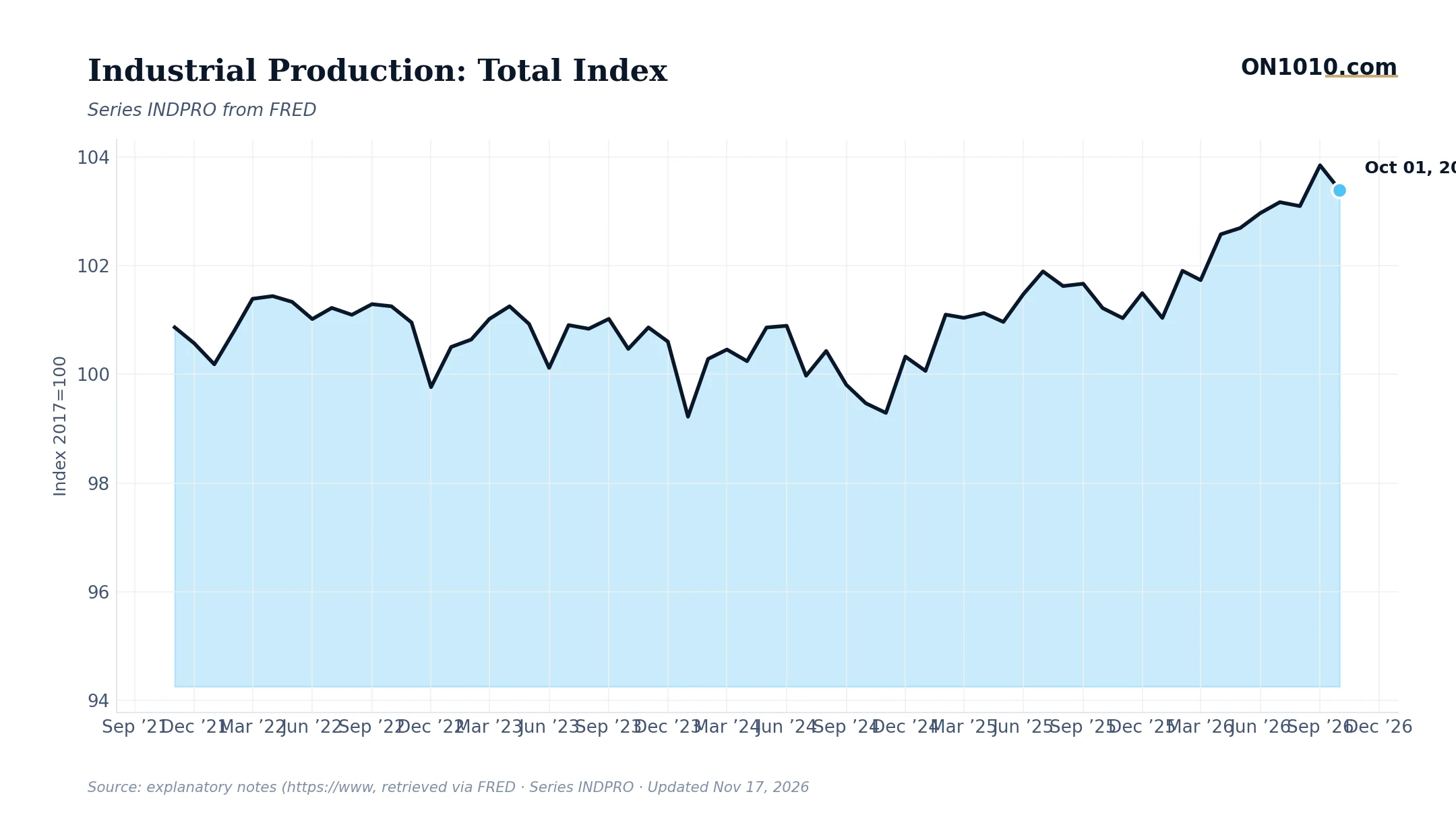
Industrial production fell 0.43% in October, pulling the index back to 103.4 after a solid September read. One month of retreat after a strong print sounds like noise. But the broader context makes this worth watching more carefully than the headline suggests.
Zoom out and the trend is actually encouraging on the surface: output has climbed roughly 0.8 points since May, and year-over-year growth sits at 1.87%. Factories are producing more than they were a year ago. The problem is the environment surrounding that modest progress. Monetary policy is restrictive by historical standards. Long-term interest rates have moved into their upper historical range and kept rising. Credit spreads are wide, signaling stress in lending markets. When borrowing costs are high and credit is tight, the capital investment that drives industrial expansion gets expensive fast, and businesses respond to that incentive whether they say so or not.
Historically, when restrictive monetary policy coincides with rising long-term rates, industrial sectors that depend on financing large equipment purchases or inventory carry tend to feel the squeeze before the broader economy does. Manufacturers pricing projects today are doing so against a significantly higher cost of capital than two years ago. In past cycles, capital-intensive industries have watched that combination carefully when deciding whether to expand capacity or hold back.
The sector rotation in markets is adding a layer here. Money has been moving out of industrials and technology and into consumer staples, health care, and utilities. Markets often lead the economy by months. When capital flows defensively while credit conditions tighten and industrial output softens, the question for business operators becomes how long the year-over-year growth number can hold if investment decisions start getting deferred.
Bottom Line: The year-over-year gain keeps industrial production in positive territory, but the headwinds piling up around it, tight money, rising rates, wide credit spreads, and shifting capital flows, are exactly the kind of combination that has historically turned modest softness into something more sustained. Watch whether October’s dip reverses in the next one or two prints, or becomes the start of a new direction.
Source: Federal Reserve Economic Data (FRED)
ON1010 Research is an independent publisher of economic education and is not a registered investment adviser, broker-dealer, or investment company. This content is for educational and informational purposes only and is not investment advice or a recommendation to buy, sell, or hold any security. Published under the publisher exemption recognized by Section 202(a)(11)(D) of the Investment Advisers Act of 1940 (Lowe v. SEC). Always consult a qualified financial professional before making any financial decision.
Free Research
The economy moves fast. We make sure you move faster.
Economic data, policy shifts, and market signals — delivered to your inbox.
Subscribe Free