
The 10-Year Yield Drops Below 5.05%, A Crack in the Wall, or Just a Breather?
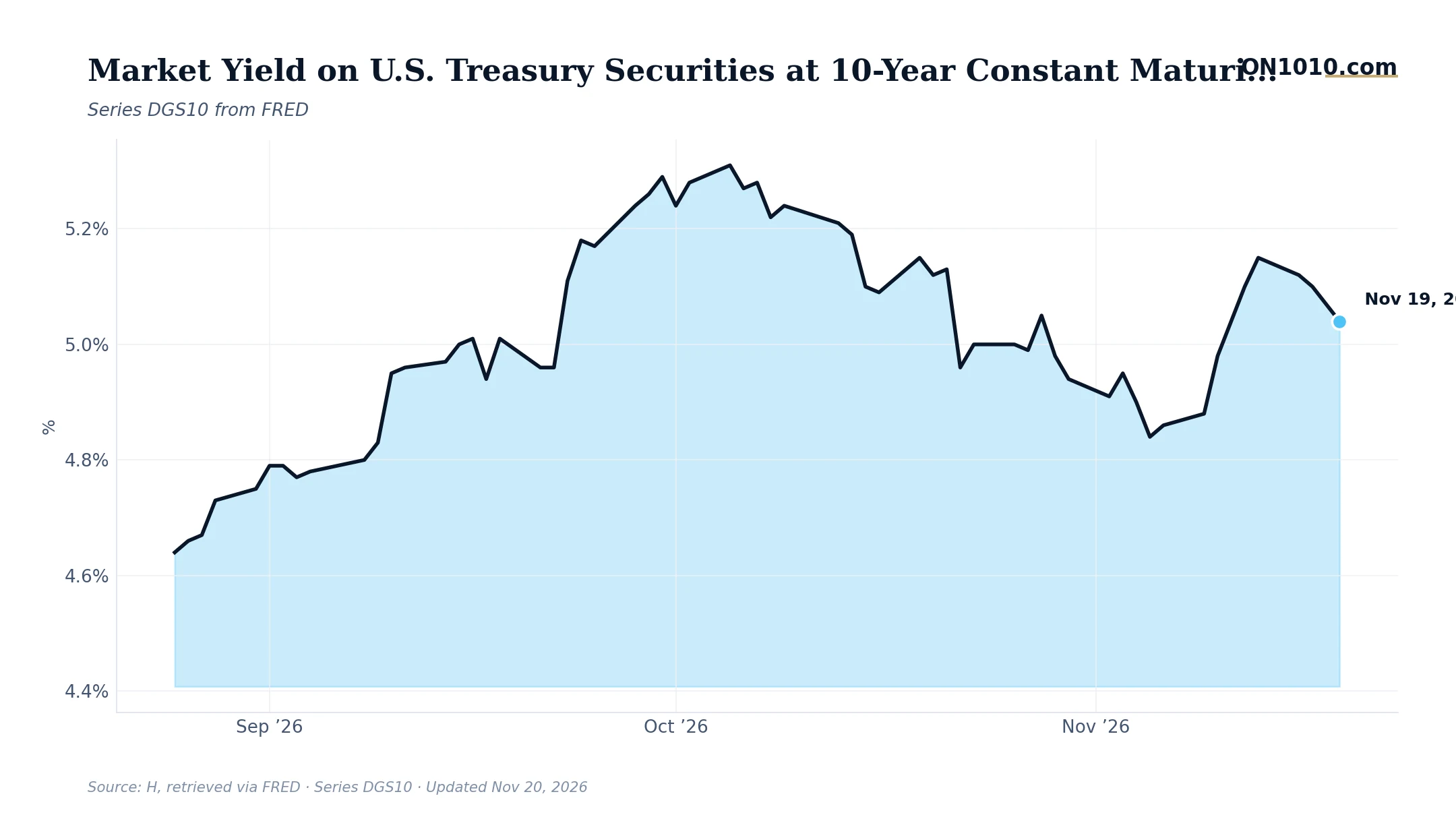
The 10-year Treasury yield slipped to 5.04% on Thursday, pulling back from a recent high of 5.15% hit just one week ago. That’s a small move in absolute terms, but watch the direction: rates have now fallen seven basis points in six trading sessions, the first consistent drift lower after weeks of relentless upward pressure.
The yield had been pushing higher as sticky inflation kept the Federal Reserve pinned in place and Treasury supply kept building. So why is it softening now? One possible answer is in the sector rotation data: defensive sectors like utilities, consumer staples, and real estate have been crushing technology and growth stocks over the past month, with defensives running roughly 8 percentage points ahead of offensives. That’s a classic flight-to-safety pattern, where investors sell risk assets and buy bonds, pushing prices up and yields down. The bond market confirming what the equity rotation is signaling: something is making institutional investors nervous.
The broader backdrop makes that nervousness understandable. Inflation remains near the top of its historical range, monetary policy is restrictive by historical standards, credit spreads are wide and rising, consumer sentiment is near historic lows, and market volatility is elevated and moving higher. That’s a lot of warning lights on at once.
Historically, when long-term rates sit this high relative to history, a recession has started within the following year about 20% of the time. That’s one in five. Worth knowing, though past patterns are not predictions. The harder question is whether the small yield decline this week is the beginning of a genuine easing in financial conditions, or just a pause before rates retest 5.15% or higher.
Bottom Line: The 10-year yield falling while defensive sectors surge and credit spreads widen is a consistent story: markets are pricing in something rougher ahead. Watch whether this yield decline holds, or whether inflation data and Treasury supply reassert upward pressure.
Source: Federal Reserve Economic Data (FRED)
ON1010 Research is an independent publisher of economic education and is not a registered investment adviser, broker-dealer, or investment company. This content is for educational and informational purposes only and is not investment advice or a recommendation to buy, sell, or hold any security. Published under the publisher exemption recognized by Section 202(a)(11)(D) of the Investment Advisers Act of 1940 (Lowe v. SEC). Always consult a qualified financial professional before making any financial decision.
Free Research
The economy moves fast. We make sure you move faster.
Economic data, policy shifts, and market signals — delivered to your inbox.
Subscribe Free