
Economic Wire: Private companies added 86,000 jobs in October, slightly hig
The Jobs Number Looks Fine. The Backdrop Does Not.
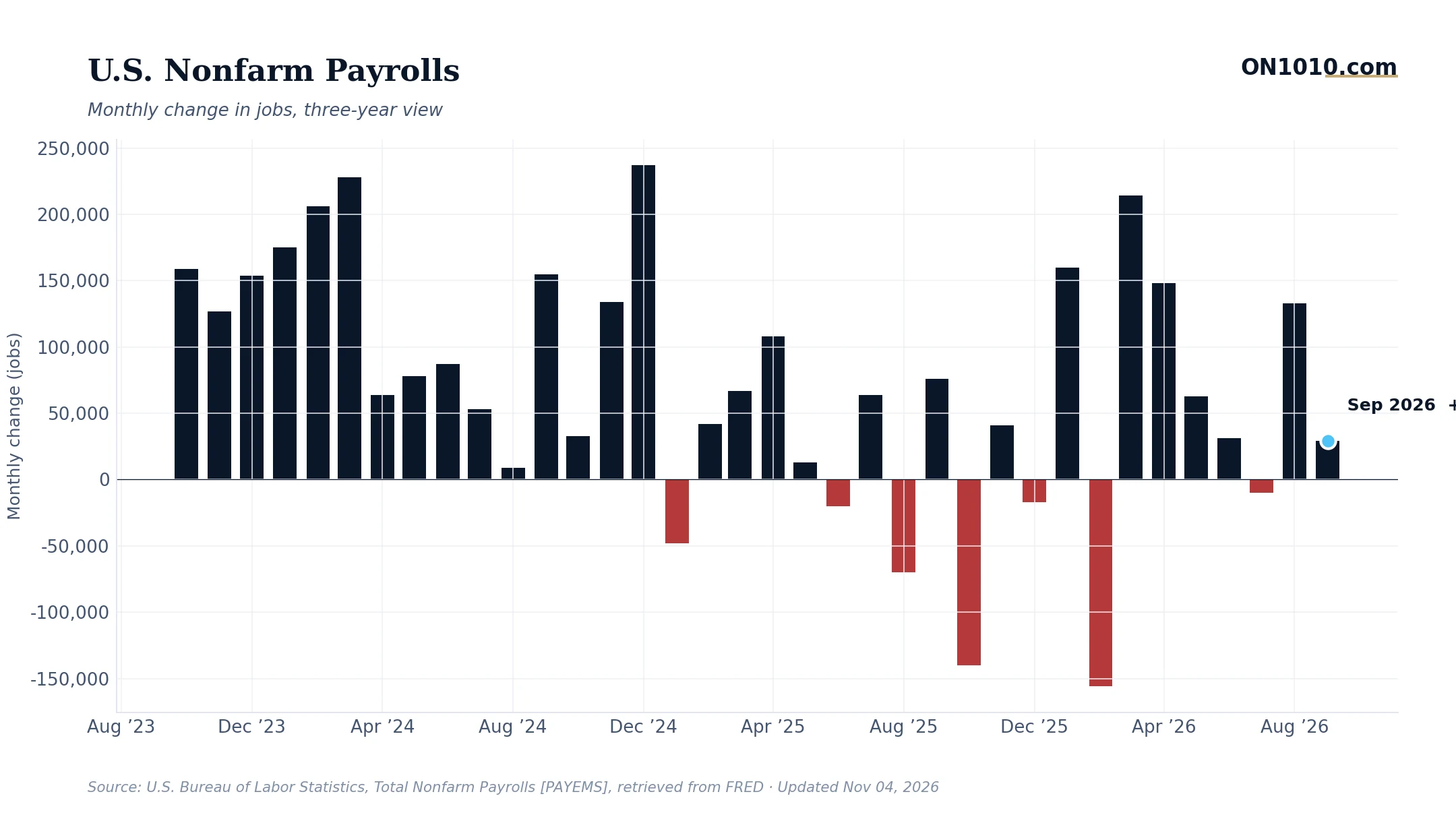
According to CNBC, private employers added 86,000 jobs in October, slightly above the consensus estimate, with gains spread broadly across sectors. That beat expectation should feel reassuring. It is harder to feel that way when you look at what surrounds it.
Eighty-six thousand is a decent number in isolation. Put it in context: private payroll growth has been running well below the pace that defined 2021 through 2023. The labor market is not collapsing, but it is clearly decelerating. And deceleration in hiring typically follows, with a lag, what businesses have already decided about investment and margins. The question is whether employers are simply normalizing after a post-pandemic hiring surge, or whether something more cautious is setting in.
The surrounding data makes that question harder to answer optimistically. Credit spreads are wide and rising, sitting near the top of their historical range, which means lenders are pricing in meaningful risk and borrowing costs for businesses are elevated even before you count the policy rate. Long-term interest rates remain high relative to history. Real monetary policy is restrictive. Consumer sentiment is near historic lows. These are not abstract concerns. Wide credit spreads raise the cost of capital, which compresses the return on new investment, which makes hiring harder to justify. The incentive structure for expansion is tight.
The sector rotation in equity markets tells a similar story. Defensive sectors, consumer staples, health care, real estate, and utilities, have sharply outperformed technology and communication services over the past month. Historically, that kind of rotation has reflected institutional investors repricing economic risk before it shows up in the hard data.
Historically, investors and business operators have watched the combination of restrictive monetary policy, wide credit spreads, and softening labor demand as a signal to watch capital allocation decisions closely. When borrowing costs are high and hiring is slowing, the question that matters is where margins are headed.
Bottom Line: The October ADP print is fine. The conditions around it are worth watching carefully.
Read more: CNBC Economy
ON1010 Research is an independent publisher of economic education and is not a registered investment adviser, broker-dealer, or investment company. This content is for educational and informational purposes only and is not investment advice or a recommendation to buy, sell, or hold any security. Published under the publisher exemption recognized by Section 202(a)(11)(D) of the Investment Advisers Act of 1940 (Lowe v. SEC). Always consult a qualified financial professional before making any financial decision.
Free Research
The economy moves fast. We make sure you move faster.
Economic data, policy shifts, and market signals — delivered to your inbox.
Subscribe Free