
One Good Month Doesn’t Fix a Broken Affordability Story
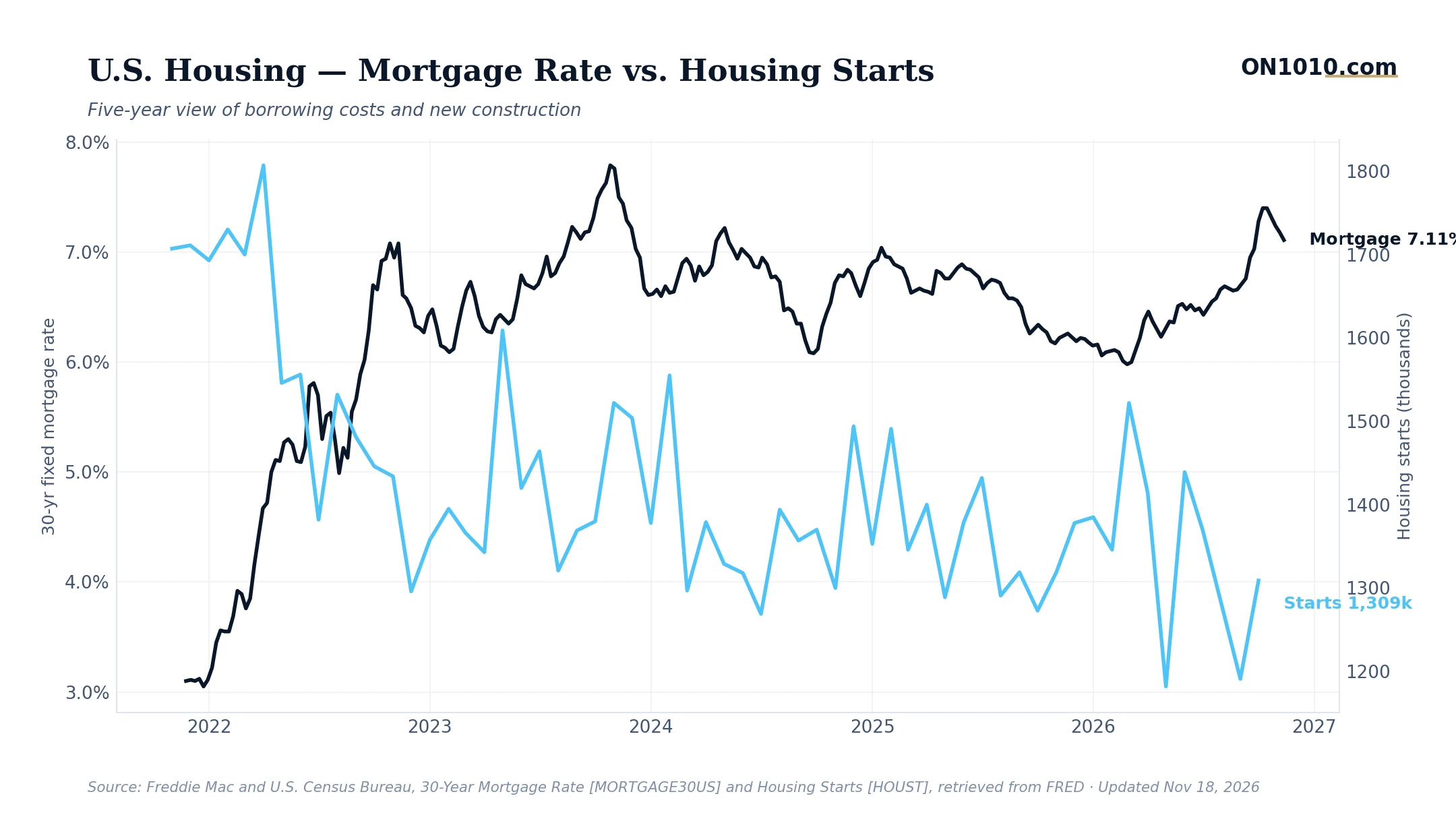
Housing starts jumped 9.9% in October to 1,309,000 units (annualized), bouncing back sharply from September’s soft 1,191,000 reading. The rebound looks encouraging on the surface. The year-over-year picture tells a quieter, more uncomfortable story: starts are still down 5% from October 2025.
The Bigger Picture
Look at the six-month trend and what you see is a range-bound market struggling to find its footing. Starts peaked at 1,439,000 in June, fell sharply to 1,182,000 in May (the worst reading of the stretch), and have been swinging in a wide band ever since. That kind of volatility is not a healthy trend, it’s a market searching for a level where builders and buyers can both say yes. The problem is that interest rates remain near the upper end of their historical range, credit spreads have widened further over the past month, and consumer sentiment is sitting near historic lows. Those three conditions don’t typically produce a sustained housing recovery.
Why It Matters
Housing is one of the most interest-rate-sensitive sectors in the economy, which is exactly why it’s worth watching closely right now. Historically, when long-term rates have held this high for this long, builders have pulled back on starts to protect margins, and buyers have stayed on the sidelines waiting for relief. The October bounce is real, but a single month reversal in a volatile series doesn’t change a trend. In past cycles, durable housing recoveries have typically required either rate relief, meaningful income growth, or a large enough supply shortage to force buyers off the sidelines despite the cost. Right now, the affordability math remains strained on all three fronts.
Bottom Line: A 10% one-month pop is easy to cheer, but housing starts are still below where they were a year ago, and the financial conditions around them, tight rates, widening credit spreads, and historically weak consumer confidence, haven’t changed. The question worth watching: are October’s gains the start of a floor, or just a noisy bounce in a structurally constrained market?
Source: Federal Reserve Economic Data (FRED)
ON1010 Research is an independent publisher of economic education and is not a registered investment adviser, broker-dealer, or investment company. This content is for educational and informational purposes only and is not investment advice or a recommendation to buy, sell, or hold any security. Published under the publisher exemption recognized by Section 202(a)(11)(D) of the Investment Advisers Act of 1940 (Lowe v. SEC). Always consult a qualified financial professional before making any financial decision.
Free Research
The economy moves fast. We make sure you move faster.
Economic data, policy shifts, and market signals — delivered to your inbox.
Subscribe Free