
The 10-Year Treasury Is Knocking on 5% Again. The Bond Market Is Trying to Tell Us Something.
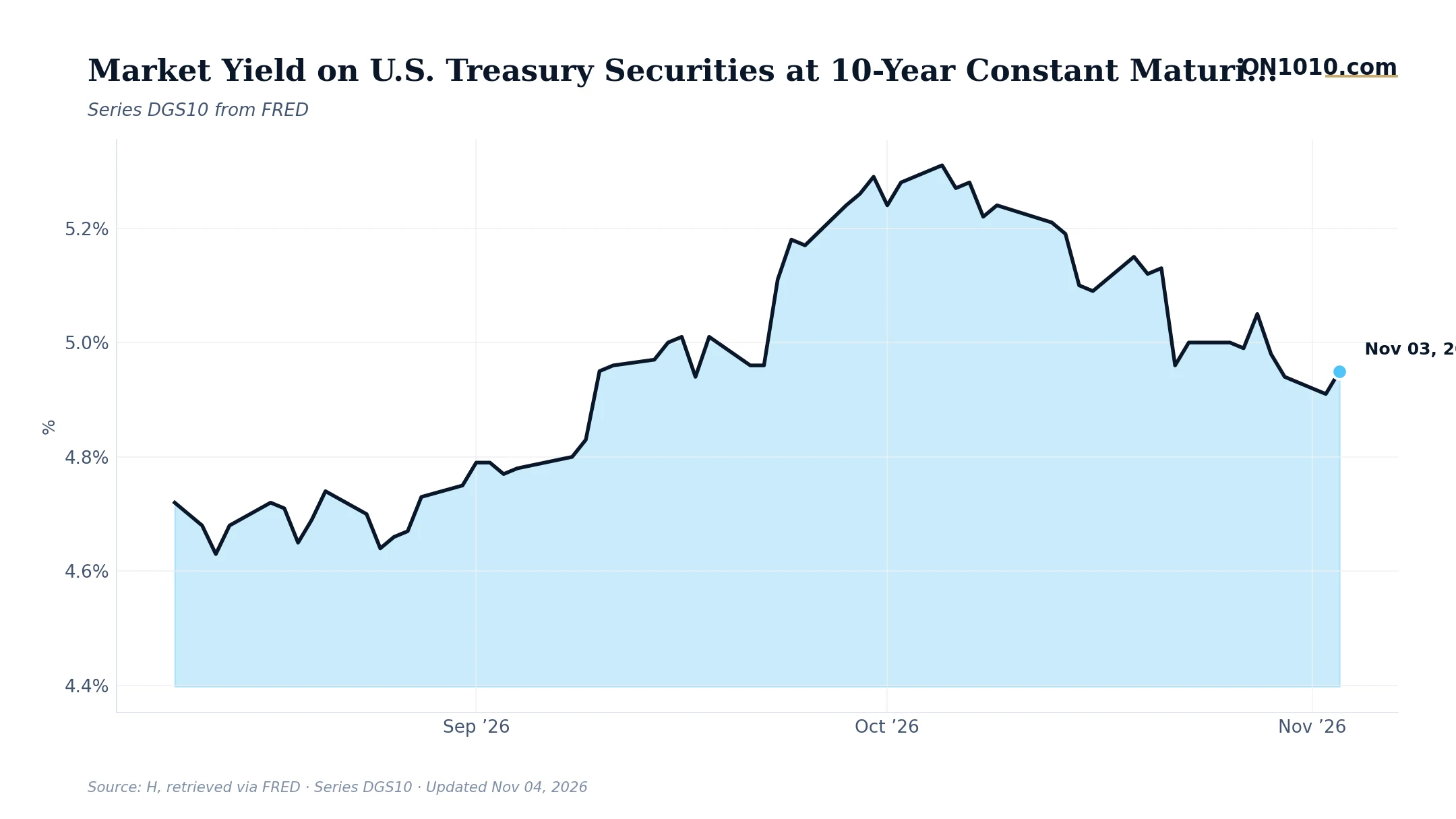
The 10-year Treasury yield closed at 4.95% on November 3, rising from 4.91% the day before, and sitting just below the 5% threshold it briefly touched at 5.05% on October 28. That is not a small number. Long-term rates are now in the upper quarter of their entire modern history, and they are not retreating.
The bigger picture here is a collision of forces. Core inflation is running hotter than roughly nine out of every ten months on record. The Fed’s policy rate is already restrictive by historical standards. And yet the bond market is pushing long-term yields higher anyway, which suggests investors are demanding more compensation for holding 10-year debt, whether that is an inflation premium, a fiscal premium, or both. When the bond market and the Fed are both leaning on the economy at the same time, the cost of capital rises across the board, including mortgages, corporate debt, and the discount rate used to value future earnings.
That last point matters for businesses and capital allocators. Historically, when long-term rates have held in this zone for an extended period, the first casualties have been rate-sensitive sectors: commercial real estate, housing, and highly leveraged companies facing refinancing decisions. Worth noting: from similar rate environments in the historical record, a new recession began within the following 12 months about 20% of the time. That is not a majority outcome, but it is not a background risk either. The question is whether margins can hold up long enough for rates to turn.
One more signal worth watching: credit spreads are widening at the same time, and institutional money is rotating hard into defensive sectors. The equity market and the bond market are both flashing the same caution.
Bottom Line: At 4.95%, the 10-year yield is not a rounding error from 5%. The question is whether this is a ceiling or a floor.
Source: Federal Reserve Economic Data (FRED)
ON1010 Research is an independent publisher of economic education and is not a registered investment adviser, broker-dealer, or investment company. This content is for educational and informational purposes only and is not investment advice or a recommendation to buy, sell, or hold any security. Published under the publisher exemption recognized by Section 202(a)(11)(D) of the Investment Advisers Act of 1940 (Lowe v. SEC). Always consult a qualified financial professional before making any financial decision.
Free Research
The economy moves fast. We make sure you move faster.
Economic data, policy shifts, and market signals — delivered to your inbox.
Subscribe Free