
The Fed Is Holding. The Real Question Is Why.
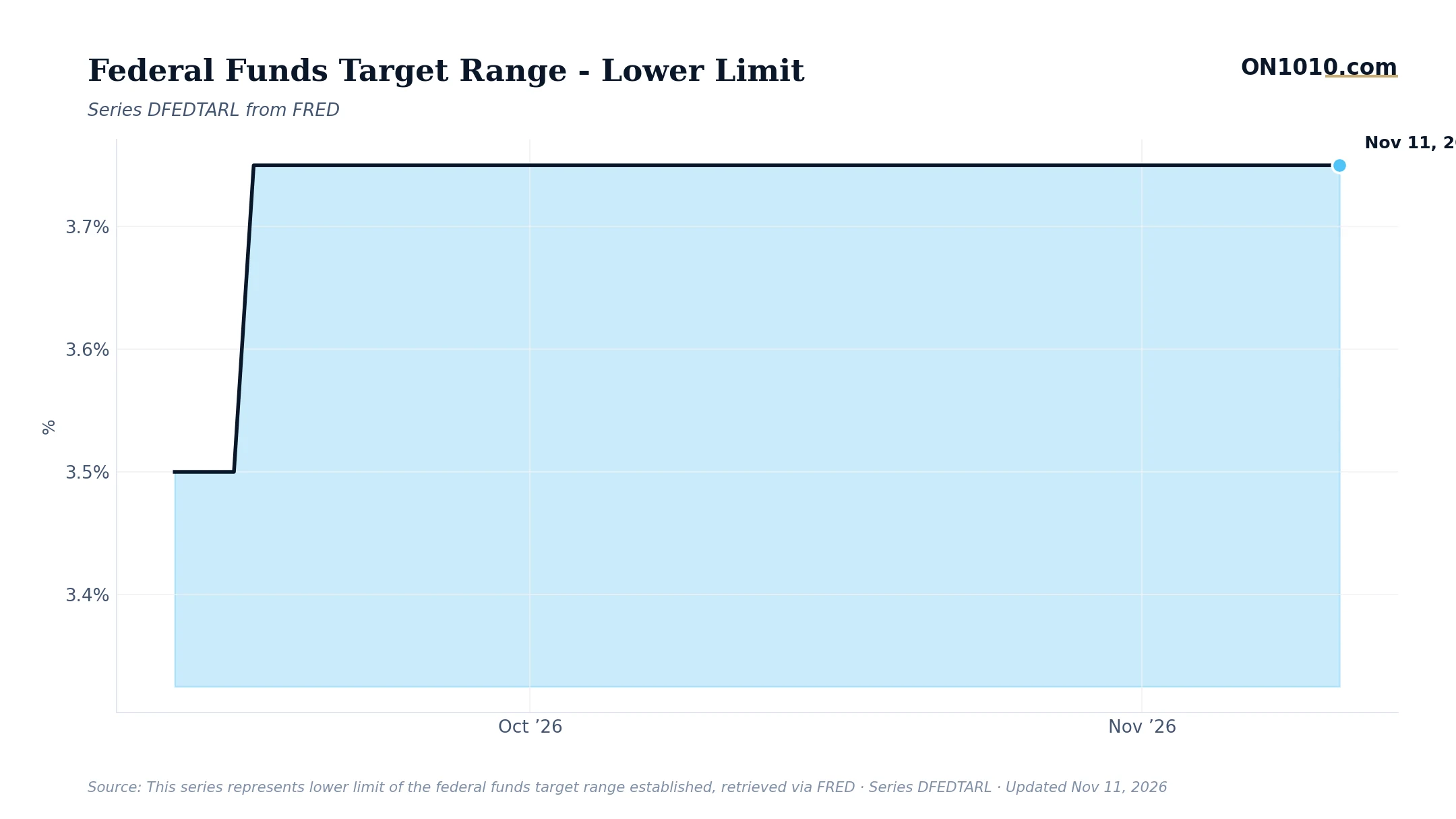
The federal funds rate target sits at 3.75%, unchanged, and showing no sign of moving.
The rate has been parked there for at least six consecutive days, which on its own means nothing. But pair that number with everything happening around it, and the story gets more interesting.
Inflation is still running hot relative to its own history, higher than roughly nine of every ten months on record. Monetary policy is restrictive by historical standards. Long-term interest rates remain elevated. Credit spreads are wide. Consumer sentiment is near historical lows. And the stock market is flashing something: defensive sectors, health care, consumer staples, real estate, utilities, are collectively outpacing offensive sectors by more than 10 percentage points over the past month. That is not random noise. Institutional money has been quietly repositioning.
Here is the tension at the center of this. The Fed is holding rates at 3.75% while inflation remains well above its 2% target. The gap between the policy rate and inflation is narrower than it looks comfortable being, and that matters: when the real policy rate (the nominal rate minus actual inflation) is thin, monetary policy is doing less tightening work than the headline number implies. Historical episodes of sticky inflation with a narrow real rate buffer have often required rates to stay higher for longer, or to be raised further, before price pressures finally eased.
In past cycles, when the policy rate was running above its long-run average and credit spreads were wide at the same time, the probability of economic stress within the following year ran meaningfully higher than average, historically around 18 to 20% based on comparable monetary environments. That is not a prediction. It is the base rate worth knowing.
Bottom Line: The Fed sitting still is not the same as the Fed being done. With inflation still elevated and the market quietly rotating toward safety, the more important question is whether 3.75% is high enough, or whether the economy is already doing the Fed’s tightening work for it.
Source: Federal Reserve Economic Data (FRED)
ON1010 Research is an independent publisher of economic education and is not a registered investment adviser, broker-dealer, or investment company. This content is for educational and informational purposes only and is not investment advice or a recommendation to buy, sell, or hold any security. Published under the publisher exemption recognized by Section 202(a)(11)(D) of the Investment Advisers Act of 1940 (Lowe v. SEC). Always consult a qualified financial professional before making any financial decision.
Free Research
The economy moves fast. We make sure you move faster.
Economic data, policy shifts, and market signals — delivered to your inbox.
Subscribe Free