
The Fed’s Rate Hasn’t Moved in Six Straight Days. That Stability Is Worth Examining.
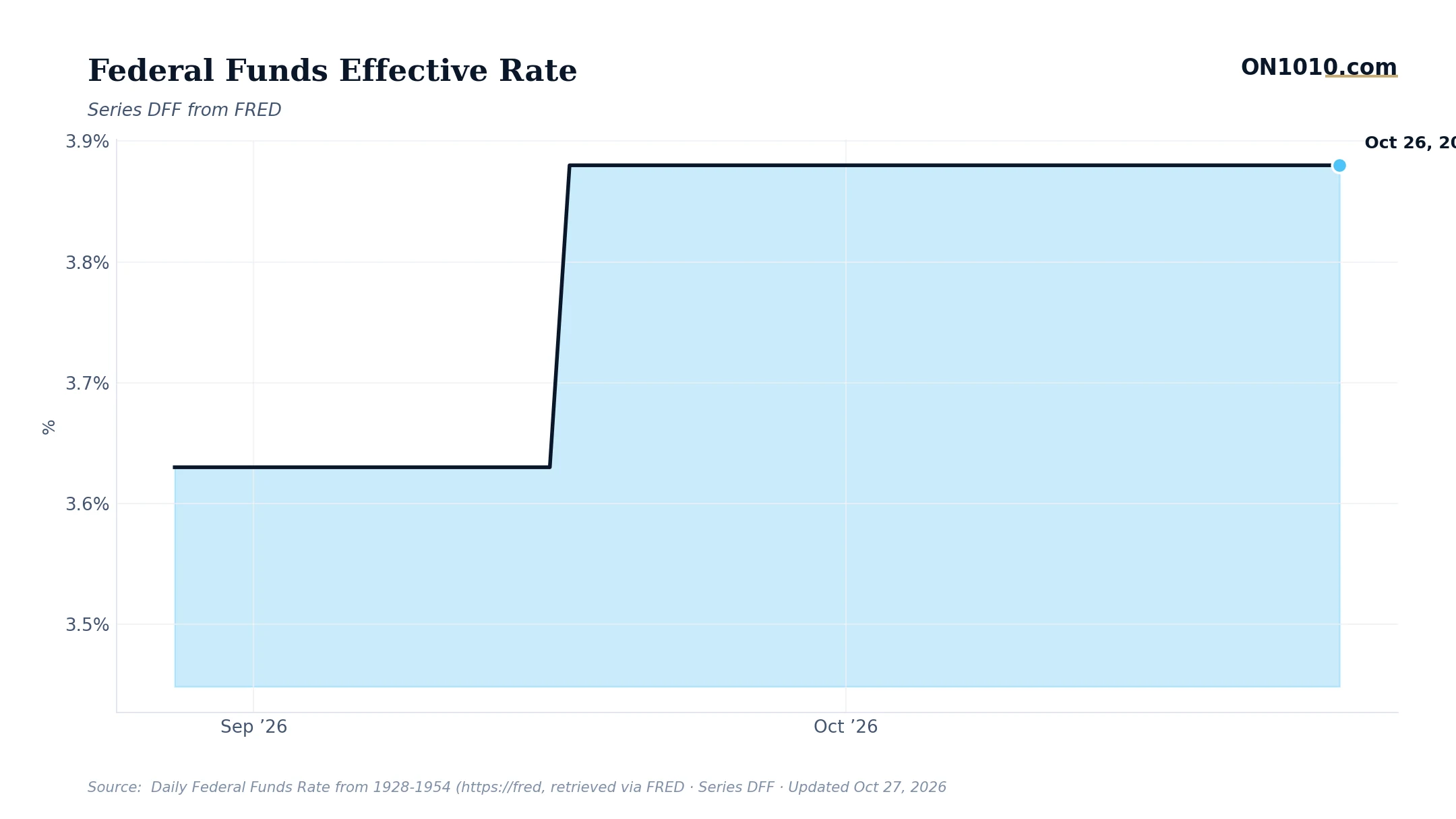
The effective federal funds rate has held at 3.88% for six consecutive trading days. No drift, no surprise. The market is doing exactly what the Fed wants, which raises a question worth thinking about: is that a sign of a healthy economy, or a sign of a system waiting for its next instruction?
The 3.88% reading places monetary policy firmly in restrictive territory relative to its long-run history, and it has been there for a while. Meanwhile, core inflation remains hot by historical standards. The gap between where the policy rate sits and where inflation is running is narrow, which means the Fed’s real inflation-adjusted grip on the economy is tighter than it appears at first glance but not dramatically so. The economic gauge picture reinforces this: growth is near its historical midpoint, consumer sentiment is near historic lows, and credit spreads are wide and rising. That last one deserves attention. Wide credit spreads mean lenders are charging more for risk, which is the credit market quietly sending a message that conditions are less comfortable than calm headline rates suggest.
Historically, when the real policy rate has been this elevated, a new recession began within the following 12 months about 18% of the time. That is not the median outcome. But it is not a trivial number either. Business leaders and capital allocators have watched this configuration before as a prompt to reassess the cost and availability of financing, since restrictive rates compress the math on leveraged investments and refinancing decisions. When long-term rates are also elevated alongside short-term rates, that double pressure is worth modeling explicitly.
Sector rotation is telling a parallel story. Defensive sectors (consumer staples, utilities, health care, real estate) have significantly outperformed over the past month, while technology and communication services have lagged. Markets are repricing risk before the data says they should have to.
Bottom Line: The fed funds rate is exactly where the Fed wants it, but the signals building around it (wide credit spreads, defensive rotation, low consumer sentiment) suggest the stability in the overnight rate is a surface reading. The deeper question is how long businesses can absorb this rate environment before it starts showing up in hiring and investment decisions.
Source: Federal Reserve Economic Data (FRED)
ON1010 Research is an independent publisher of economic education and is not a registered investment adviser, broker-dealer, or investment company. This content is for educational and informational purposes only and is not investment advice or a recommendation to buy, sell, or hold any security. Published under the publisher exemption recognized by Section 202(a)(11)(D) of the Investment Advisers Act of 1940 (Lowe v. SEC). Always consult a qualified financial professional before making any financial decision.
Free Research
The economy moves fast. We make sure you move faster.
Economic data, policy shifts, and market signals — delivered to your inbox.
Subscribe Free