
The Job Market’s Quiet Strength Is Being Tested
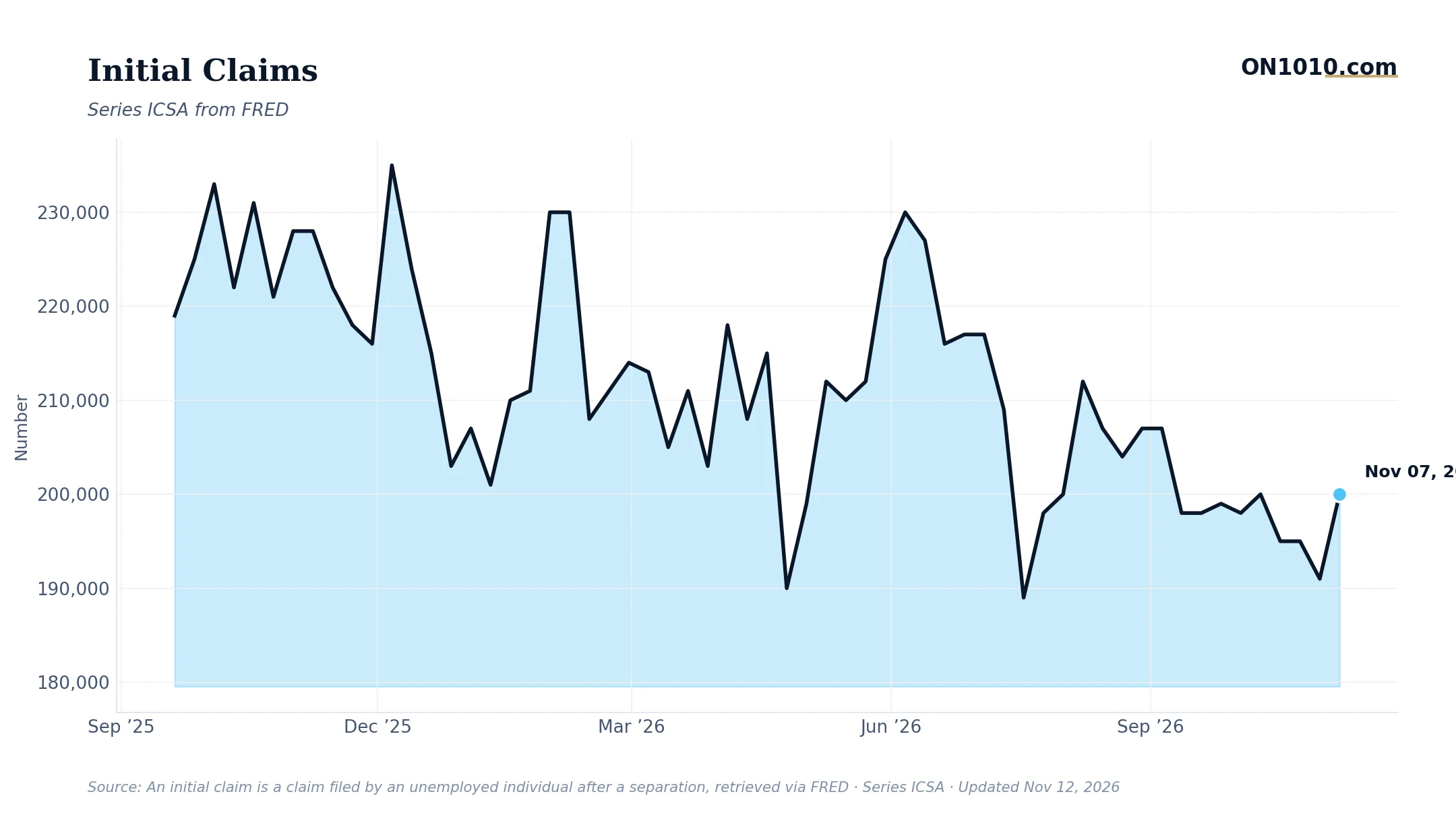
Initial jobless claims rose to 200,000 for the week ending November 7, up 9,000 from the prior week’s 191,000. On its face, that sounds like the beginning of a crack. Look at the six-week trend, though, and it reads differently: claims have been bouncing between 191,000 and 200,000 since early October, essentially flat.
The labor market, by this measure, remains historically tight. Claims at 200,000 sit well below the levels that have historically signaled serious stress. But the broader context makes this worth watching more carefully than the number alone suggests.
Here is what the economy around this data point looks like right now. Inflation is running hot by historical standards. The policy rate is in restrictive territory. Long-term interest rates are in the upper quarter of their historical range. Credit spreads are wide, a sign that lenders are pricing in more risk. Consumer sentiment is near its historical floor. And in equity markets, money has been rotating hard into defensive sectors like health care and consumer staples, while technology has underperformed sharply. Markets often reprice before the economy moves. That rotation deserves attention.
Historically, claims in this range have coexisted with continued economic expansion. The labor market tends to be the last domino to fall in a cycle, which is precisely why analysts watch it so carefully. In past cycles with restrictive monetary policy and wide credit spreads, the leading indicators softened for months before jobless claims began a sustained move higher. The question worth asking is whether the current readings in credit and sentiment are early warning or noise.
Bottom Line: Claims are still low by any historical measure, but the conditions surrounding the labor market, tight money, stressed credit, defensive positioning in equities, and weak consumer confidence, look more like late-cycle than mid-cycle. The job market has held. The question is what it looks like six months from now if those pressures persist.
Source: Federal Reserve Economic Data (FRED)
ON1010 Research is an independent publisher of economic education and is not a registered investment adviser, broker-dealer, or investment company. This content is for educational and informational purposes only and is not investment advice or a recommendation to buy, sell, or hold any security. Published under the publisher exemption recognized by Section 202(a)(11)(D) of the Investment Advisers Act of 1940 (Lowe v. SEC). Always consult a qualified financial professional before making any financial decision.
Free Research
The economy moves fast. We make sure you move faster.
Economic data, policy shifts, and market signals — delivered to your inbox.
Subscribe Free