
The Yield Curve Is Positive Again. That Might Actually Be the Harder Problem.
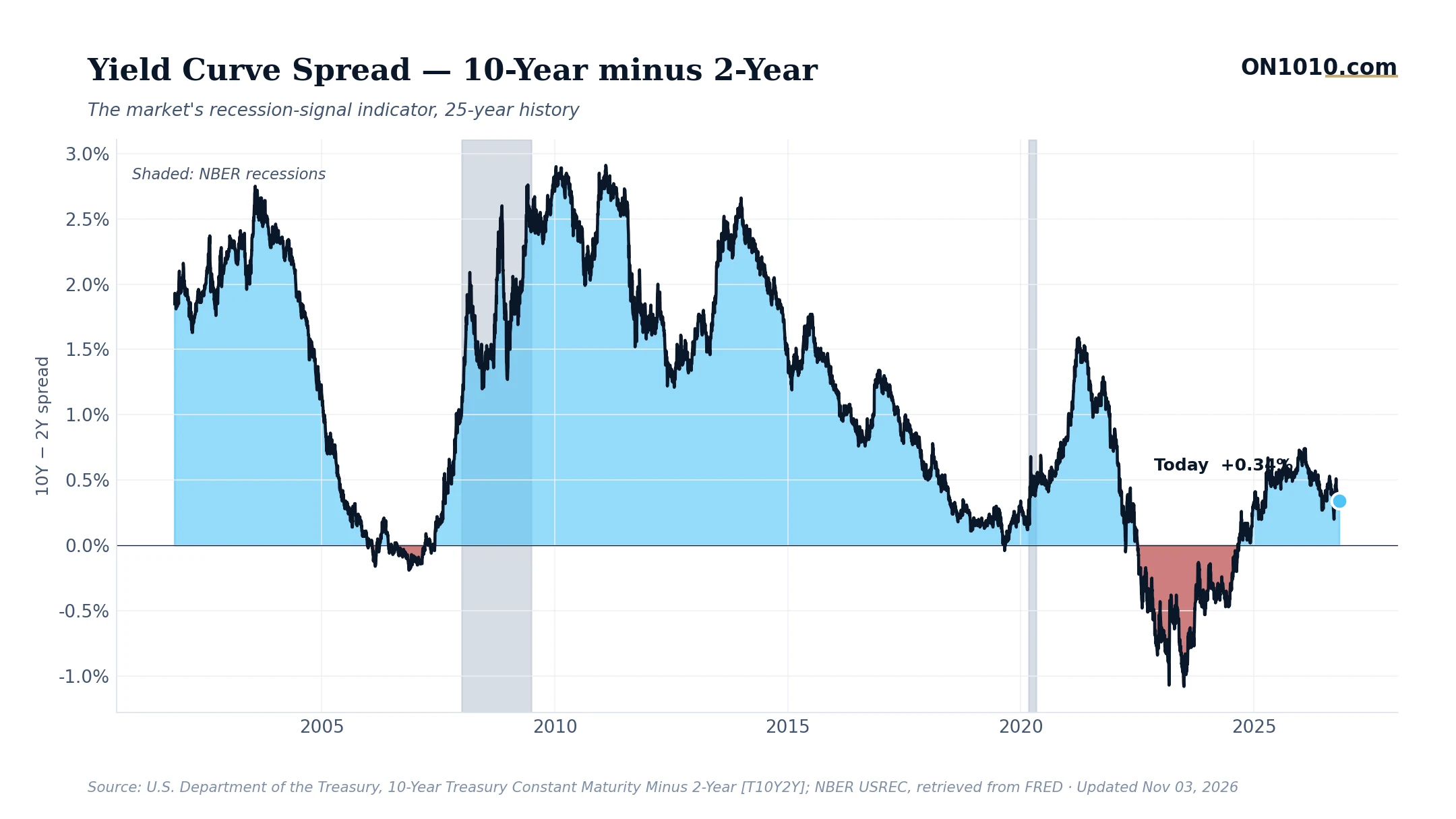
The 10-year/2-year Treasury spread sits at 0.34% as of November 3, up slightly from 0.32% the day before. The curve has been positive for a while now, which means the bond market is no longer flashing the classic recession warning it spent most of the past few years broadcasting. Good news, right? Maybe. But a yield curve re-steepening after a deep inversion has its own complicated history, and this one is happening against a backdrop that deserves a closer look.
The spread has been drifting between 0.29% and 0.38% over the past week, a narrow range that suggests the bond market is in a holding pattern. Longer-term rates remain high by historical standards and have recently started falling, while credit spreads have moved wider into territory that historically reflects stress in the credit markets. Those two things together, a flattening long end and widening spreads, often show up when investors are beginning to price in something they cannot quite name yet. Consumer sentiment is near the bottom of its historical range, and sector rotation in equity markets has shifted hard toward defensive names like consumer staples, utilities, and health care, with technology and communication services lagging badly.
Historically, the period right after a yield curve un-inverts has been worth watching carefully. In past cycles, the spread turning positive again often meant the economy had not yet felt the full weight of the prior inversion. The lag between monetary tightening and its real economic effects has historically run 12 to 18 months. With monetary policy still restrictive by historical standards and inflation still running hot, the question worth asking is whether the worst is ahead rather than behind.
In past cycles, investors and business operators have used the re-steepening phase to reassess financing costs, refinancing timelines, and the duration of any debt on their books, since long-term rates tend to reprice faster than short-term rates in this phase. The combination of rising credit spreads and elevated long-term rates raises the cost of capital for businesses that need to borrow, which eventually shows up in investment decisions.
Bottom Line: A positive yield curve means the loudest recession alarm has stopped ringing, but history says the all-clear is premature. The question is what the bond market is pricing into the long end now, and whether that story matches what credit spreads and equity flows are already telling us.
Source: Federal Reserve Economic Data (FRED)
ON1010 Research is an independent publisher of economic education and is not a registered investment adviser, broker-dealer, or investment company. This content is for educational and informational purposes only and is not investment advice or a recommendation to buy, sell, or hold any security. Published under the publisher exemption recognized by Section 202(a)(11)(D) of the Investment Advisers Act of 1940 (Lowe v. SEC). Always consult a qualified financial professional before making any financial decision.
Free Research
The economy moves fast. We make sure you move faster.
Economic data, policy shifts, and market signals — delivered to your inbox.
Subscribe Free