
The Yield Curve Is Positive Again. That’s Not Necessarily Good News.
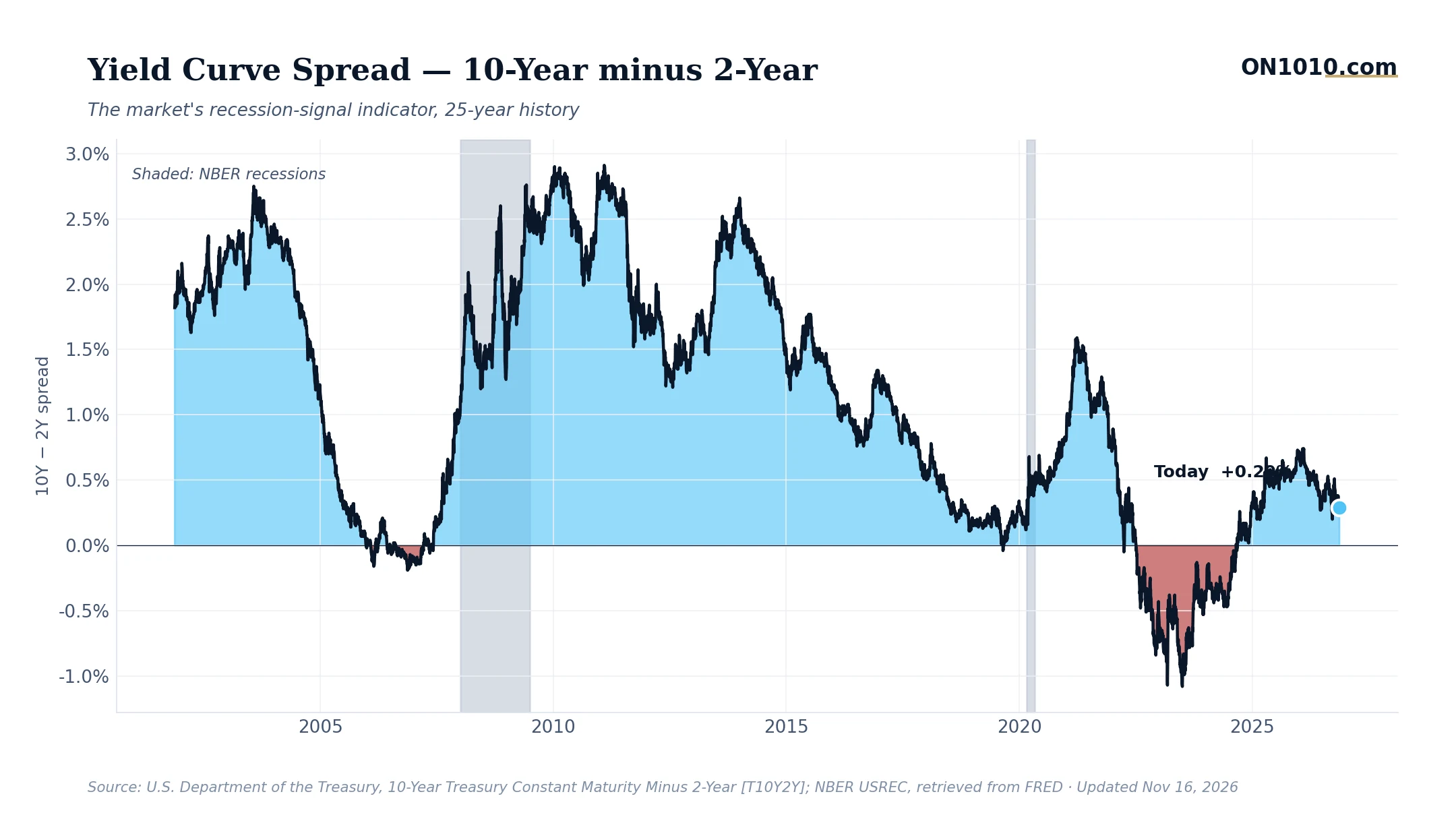
The 10-year/2-year Treasury spread widened to 0.29% on November 16, up from 0.27% two days earlier. After spending much of the past two years deeply inverted, the curve has now been positive for several months. On the surface, that sounds like a green light. The history here is more complicated.
The yield curve’s inversion was the story from 2022 through most of 2024. But the inversion ending doesn’t mean the danger has passed. In past cycles, the curve has often re-steepened sharply just as economic conditions started deteriorating. The mechanism: short-term yields fall when the Fed cuts rates in response to weakening growth, while long-term yields stay elevated because bond investors see higher deficits ahead. The spread widens, but for the wrong reasons.
That’s the puzzle worth watching right now. The broader dashboard is sending a complicated set of signals. Inflation remains well above its historical norm. Monetary policy is still restrictive by historical standards. Long-term interest rates sit in their upper historical range. Credit spreads are wide and rising. Consumer sentiment is near multi-decade lows. Meanwhile, sector rotation data shows defensive industries (consumer staples, health care, real estate, utilities) each running roughly 8 percentage points ahead of SPY over the past month, while technology is trailing by nearly 8 points. Capital has been rotating toward safety, not opportunity.
Historically, a yield curve that re-steepens while monetary policy remains tight and credit conditions are deteriorating has sometimes been a warning sign rather than a signal of recovery. When rates stay high and long-term yields climb alongside short-term yields, businesses refinancing debt or planning capital investments face a genuinely tougher environment. Historical readings like these have preceded recessions within 12 months roughly 18% to 20% of the time, depending on which gauge you lean on. Base rates, not forecasts, but worth knowing.
Bottom Line: A positive yield curve after a long inversion feels like relief. The question is whether this spread is widening because the economy is strengthening, or because bond markets are pricing in something harder ahead.
Source: Federal Reserve Economic Data (FRED)
ON1010 Research is an independent publisher of economic education and is not a registered investment adviser, broker-dealer, or investment company. This content is for educational and informational purposes only and is not investment advice or a recommendation to buy, sell, or hold any security. Published under the publisher exemption recognized by Section 202(a)(11)(D) of the Investment Advisers Act of 1940 (Lowe v. SEC). Always consult a qualified financial professional before making any financial decision.
Free Research
The economy moves fast. We make sure you move faster.
Economic data, policy shifts, and market signals — delivered to your inbox.
Subscribe Free